atrial fibrillation, apple watch
AF update: what four months of data has (and hasn't) told me
In my last post, at the start of August, I'd just had a touch-up ablation at LGI on 13 July and stopped bisoprolol three days before. The plan was simple: get through the three-month blanking period, stay off the beta-blocker, and see where things settled.
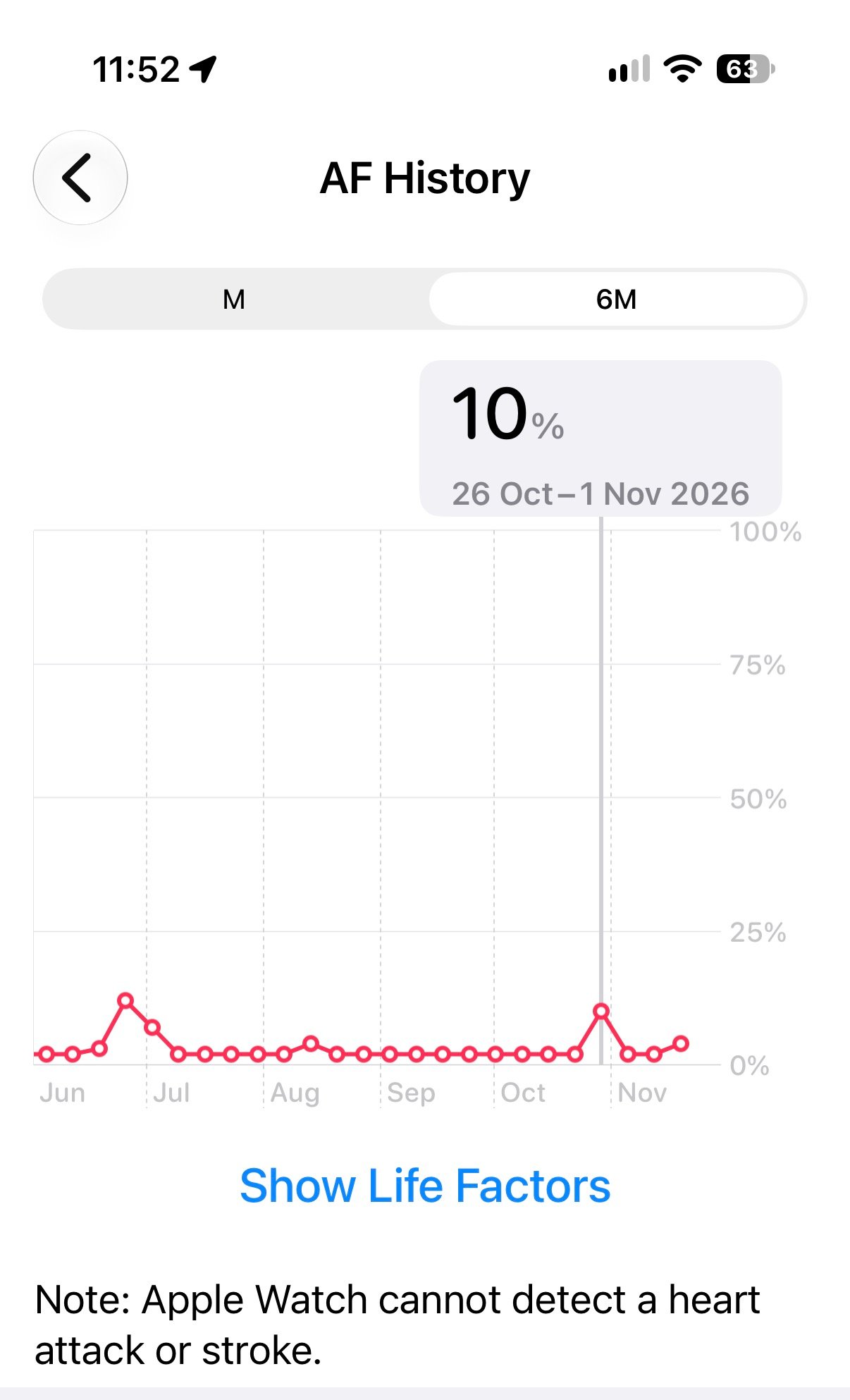
Four months on, the short version is that the touch-up has done a lot of good, but it hasn't fixed everything. In almost every week since, my background AF burden has sat at the lowest level the Apple Watch reports. But hard exercise still sets off episodes, and the last few weeks have thrown in a few new triggers.
I've also done something I've been meaning to do for years: put all my data in one place and go through it properly. That's 1,576 Apple Watch ECGs going back to 2019 and every Strava activity since 2020, checked second by second, plus blood tests and a new overnight heart-rate measure. I did the analysis with the help of Claude (an AI). Everything here is pattern-finding for my own understanding and to take to the LGI arrhythmia team, not medical advice.
The blanking period and October
The first few months after an ablation are called the blanking period. The heart is healing and irritable, so early episodes are common and don't count as failure. Mine ran to about 13 October, and I had my share:
| Date | What I was doing | What happened |
|---|---|---|
| 11 Aug | Zwift race, straight in with no warm-up ride | Heart rate jumped from 140 to 177 on a surge and stayed high after I stopped. AF on the watch ECG that evening. |
| 5 Sep | Parkrun | Heart rate locked at 155-165 and stayed there on the walk home. |
| 12 Sep | Parkrun | A possible short episode about 6 minutes in. |
| 18 Sep | Indoor skiing, after a big curry the night before and burger and chips for lunch | Heart rate jumped to 150-166 while standing still. |
The blanking period ended, and then October brought three more in ten days:
- 17 Oct, Porto: a big day on the bike, then a large evening meal and an easy ride back. AF on a short uphill at about 22:15.
- 24 Oct: a parkrun attempt after a bloated breakfast. My heart rate locked at 155-160 three minutes in. The ECG showed a very regular 153 bpm, which the Qaly service read as SVT. That looks more like flutter or atrial tachycardia than AF.
- 27 Oct: a fasted morning run. AF at 133 bpm after about 1.2 km. About four hours in I took a bisoprolol, and I was back in normal rhythm within two hours.
That last one is what pushed me to go through all the data properly.
Putting all the data in one place
I've been wearing an Apple Watch and logging everything on Strava for years, but I'd never looked at it all together. So I exported the lot:
- Apple Health: every heart-rate reading, HRV reading, sleep record and workout, plus all 1,576 ECGs since September 2019, with the raw traces.
- Strava: all 1,759 activities since 2020 with heart rate, checked second by second for the tell-tale signs of an episode starting: heart rate jumping and locking flat, or staying high after I'd stopped.
- Blood tests: a Bluecrest wellness panel in October and NHS bloods in November.
- Recovery HRV: a new overnight measure the watch has started recording this autumn, exported weekly with the Health Auto Export app.
- A food and symptom log: an iPhone Shortcut I built to log meals, drinks, bloating and other symptoms with a couple of taps.
It all lives in a database I can now ask questions of, which is how most of what follows came about. A couple of things needed sorting first. Some hockey sessions were recorded as runs, so they had to be moved. And the Apple Watch occasionally fails to lock on and draws a perfectly flat line at a high heart rate, which looks a lot like an episode but isn't.
What the data says about exercise
The type of exercise matters a lot. Since 2020, this is how often each kind of session was followed by an episode within three hours:
| Activity | Sessions followed by an episode |
|---|---|
| Zwift races | 19 of 116 (16%) |
| Saturday-morning runs (parkrun-type) | 9 of 76 (12%) |
| Other cycling | 73 of 664 (11%) |
| Field hockey | 16 of 164 (10%) |
| Other running | 25 of 274 (9%) |
| Strength training | 6 of 180 (3%) |
| Yoga and Pilates | 3 of 142 (2%) |
| Skiing | 1 of 83 (about 1%) |
| Hiking | 0 of 94 |
Hiking has never set it off. Strength work, yoga and skiing barely have. Racing, hockey and hard runs and rides are where the risk is.
Going above about 160 bpm is the line. Looking at every run, ride and hockey day since September 2025:
| Highest heart rate that day | Days | Followed by an episode |
|---|---|---|
| Under 150 | 63 | 2 |
| 150-159 | 20 | 2 |
| 160 or more | 44 | 15 (34%) |
It didn't matter how long I spent above 160: a minute or two carried the same risk as ten. And nothing I could measure beforehand predicted which hard days would go wrong. Sleep, resting heart rate, overnight HRV, breathing rate, training load over the previous week and rest days were all the same on good and bad days.
The warm-up isn't the answer I thought it was. For a while I was convinced a proper gradual warm-up was the key, because at Wetherby parkrun I usually run up the hill from the car park from cold. Looked at properly, it doesn't hold up. Gentle starts are mostly easy sessions, and once you compare sessions that got equally hard, the rate was about one in five whatever the start. Two Zwift races this spring followed 12-13 minutes of steady warm-up, and both still set off an episode. What might matter more is a sudden step up in effort: twice, AF started within a minute of the first big surge after a gentle start. A gradual warm-up costs nothing, so I'll keep doing it, but it isn't protection.
Weekly training volume doesn't matter either. It's how hard I go, not how much I do.
Something changed around March 2026. In the six months after my Mini Maze surgery settled down (September 2025 to February 2026), I went above 160 on 20 days and had two episodes. From March to July, the same kind of effort set one off about half the time (6 of 11). Since the touch-up it's 7 of 13 days, although that's a small number and partly inside the blanking period. The touch-up found that one of the veins isolated by the Mini Maze had reconnected, which fits with the relapse. At the same time, my resting heart rate drifted down from about 59 to 54, and the night-time irregular readings on the watch rose. One possibility is that the nerve supply to the heart was recovering after surgery. That's a question for the team.
The touch-up did fix the background AF. In 2024-25 my weekly AF burden averaged about 10%, with peaks of 31%. Since July it has been at the watch's 2% floor in almost every week. What's left is the exercise trigger.
Some episodes may not be AF at all. On six or seven occasions the ECG after a hard effort showed a very regular rhythm at 130-160 bpm, often an hour or two after I'd stopped. A normal heart rate doesn't stay that high and that regular at rest. It fits atrial flutter or atrial tachycardia, which are common after surgery and ablation, and sometimes turn into AF later the same day.
What happens at night
AF scrambles the timing between heartbeats, and the watch's HRV readings jump when that happens. A normal overnight reading for me is about 20 ms; in AF it shoots past 100. Checked against my ECGs, about half of my abnormal ECGs had a reading of 80 ms or more close by, against only 2% of normal ones. So the HRV readings give me a rough rhythm record for every night, not just when I happen to take an ECG.
Two different things show up:
- Proper episodes: a run of high readings lasting 10 minutes or more, usually with my heart rate rising too.
- Single blips: one high reading with normal ones either side and no change in heart rate. These are probably the odd extra beat (an ectopic). One early beat followed by a pause is enough to send the reading sky high.
High night-time readings rose from about 2% of the total in late 2025 to 8% in June 2026, right alongside the relapse. Since the touch-up they've dropped back to about 2-3%.
This autumn the watch also started recording Recovery HRV, a different measure (rMSSD) taken every five minutes or so while I'm asleep. My baseline is about 12 ms. In the 25 nights up to 13 October there wasn't a single reading above 70. From 13 to 29 October, six of 17 nights had one, including the whole night of 27-28 October in AF. That's now my weekly check: any run of high readings, and whether my heart rate rose with them.
Blood tests and supplements
I wanted to rule out the usual reversible causes of AF, so I had two sets of bloods done.
| Test | Result | What it means |
|---|---|---|
| Thyroid (TSH) | 1.52 | Normal. An overactive thyroid is a classic AF cause, so this was an important one to rule out. |
| Potassium | 4.3 mmol/L | Mid-range, so not a factor. |
| Kidney function | Normal | eGFR over 90. |
| Sodium | 146 mmol/L | Top of the range, probably just hydration. Worth repeating. |
| Magnesium | 0.8 mmol/L | Within the NHS range (0.7-1.0) but below the 0.85 Bluecrest flag. |
| Vitamin D | 65 nmol/L | In range, but below the 75 often quoted as ideal. |
| Zinc | 11.29 µmol/L | Marginal. |
Everything else (cholesterol, blood count, liver, glucose, iron) was normal.
Magnesium is the only thing that came back borderline, and low magnesium is known to make the heart more prone to extra beats and AF. So from 30-31 October I've been taking magnesium taurate (112 mg of magnesium a day) plus a multivitamin that adds another 60 mg, with zinc and vitamin D. I tried doubling the taurate for a few days in November, and from 12 November I've settled on taurate in the morning and the multivitamin in the evening.
The plan is to run this until mid-December, compare the before and after, and retest magnesium in late January. So far it's encouraging but nowhere near proof: nights since starting have had fewer runs of high readings, and mostly single blips. But I've also done far fewer hard sessions, and the one hockey session I did (4 November) still set off AF.
November: a bug and two beers
November started quietly. Apart from AF after the hockey session on the 4th, the only rough nights came later in the month, and both while I was ill.
I spent 12-15 November walking in the Lake District, which went fine, as hiking always has. But I was coming down with something, and by the time I got home I had a sore throat, a muzzy head and a sleeping heart rate up from about 60 to the low 70s.
- 16-17 November: after an indoor ski session with moguls (peak 160), the watch's HRV readings went haywire from midnight to about 4:40. But my heart rate stayed flat at 66-71 the whole time, and the high readings came in short bursts. The ECGs I took either side were normal rhythm, each with one extra beat in it. That looks like clusters of ectopic beats rather than AF, brought on by the bug. It didn't wake me.
- 18-19 November: still ill, I had two beers in the evening, which I very rarely do. AF started at about 23:10 and lasted most of the night, about seven hours, possibly with a break in the middle. It stopped on its own by about 6:15.
That's the first time alcohol has looked like a trigger for me. Alcohol is a well-known one, and for some people even a drink or two will do it. But I was also ill, and illness had already produced a night of extra beats two days earlier. My best guess is the bug made my heart irritable and the beer tipped it over. Either way, no more alcohol until I'm well, and I'll treat it with caution after that.
Since then, things have settled. The last four nights have been clean, with no high readings at all, and my resting heart rate is back down to 63. I also did a ride on 21 November that went over 160, the first since the hockey, and that night was quiet too.
What I'll be asking, and what's next
Putting it all together, my AF now has three routes in: hard exercise above about 160, big meals or bloating late in a long day, and illness, possibly with alcohol on top. Hard exercise is by far the most common. It isn't a simple rule, though: even on days I go above 160, two times in three nothing happens. That's how paroxysmal AF works. It needs a susceptible heart and a trigger arriving at the wrong moment.
The questions I'll be taking to the arrhythmia team:
- Is the regular fast rhythm I sometimes get after hard efforts a flutter or atrial tachycardia, and if so, could it be mapped and ablated?
- Would an exercise test, or an EP study, help reproduce and pin down the trigger?
- Would it make sense to take bisoprolol only before hard sessions or races, rather than every day?
- Could I have an overnight monitor to tell whether the night-time blips are ectopics or short bursts of AF?
- Is the touch-up still settling, or is this as good as it gets?
In the meantime:
- Treat races, parkruns and hockey as higher risk, and build back gradually once I'm over this bug.
- Keep hiking, skiing, strength work and steady rides, which have been consistently safe.
- Run the magnesium and multivitamin to mid-December, then compare, and retest magnesium in January.
- Keep the weekly watch exports going, so the next update has even more to go on.
As always, this is my own data and my own reading of it, done with an AI to help crunch the numbers. It's not medical advice, and anyone with AF should talk to their own team before changing anything.